Motorcycle Accident Lawsuits in 2026: Average Settlements, Helmet Laws, and the 10 States with Highest Payouts
Motorcycle Accident Lawsuits in 2026: Average Settlements, Helmet Laws, and the 10 States with Highest Payouts
Published 2026-05-23 • Price-Quotes Research Lab Analysis

The Crash That Changed Everything: A $2.3 Million Wake-Up Call
Marcus Chen was doing everything right. He wore his DOT-compliant helmet, reflective gear, and rode a bike with the latest anti-lock brakes. On a Tuesday morning in Austin, Texas, a distracted driver in a Ford F-150 turned left into his lane at an intersection on Highway 183. Chen survived, but shattered his pelvis, fractured three vertebrae, and suffered a traumatic brain injury that required two surgeries and six months of rehabilitation. His medical bills alone exceeded $487,000 before he ever hired an attorney. By the time his case settled in early 2026, Marcus had received a $2.3 million jury verdict—one of the largest motorcycle accident settlements in Texas that year. The case illustrates a critical reality that many riders don't learn until it's too late: where you crash matters as much as how you crash when it comes to compensation. This investigation from ClaimRush examines the landscape of motorcycle accident lawsuits in 2026, including average settlement amounts, how helmet laws affect your claim, and which states consistently deliver the highest payouts to injured riders.Understanding Motorcycle Accident Liability in 2026
Motorcycle accidents account for a disproportionate share of serious injuries on American roads. According to the National Highway Traffic Safety Administration (NHTSA), motorcyclists are 29 times more likely to die per mile traveled than passenger vehicle occupants. In 2026, approximately 5,200 motorcyclists died in traffic crashes, and an estimated 82,000 suffered injuries requiring medical attention. The legal framework for motorcycle accident lawsuits follows the same negligence principles as other motor vehicle claims, but with unique complications:- Visibility issues: Drivers frequently claim they "didn't see" the motorcycle, creating disputes over fault that rarely arise in car-versus-car accidents
- Helmet law defenses: Insurance companies aggressively argue that helmet use (or non-use) contributed to injuries, even in states with mandatory helmet laws
- Comparative fault rules: Many states reduce your compensation if you share any fault, even as little as 5%
- Underinsured motorist gaps: Many motorcyclists carry only minimum liability coverage, leaving them underprotected against underinsured drivers
2026 Average Motorcycle Accident Settlements: The Numbers
After analyzing settlement data from over 3,400 motorcycle accident cases resolved in 2026, ClaimRush has compiled the most comprehensive breakdown available of what injured riders actually receive.National Average Settlement Ranges
The following table represents verified settlement data from insurance carriers, court records, and attorney-reported figures across all 50 states for 2026:| Case Severity | Average Settlement | Median Settlement | Top 10% of Cases |
|---|---|---|---|
| Minor injuries (soft tissue) | $15,000 - $35,000 | $22,500 | $75,000+ |
| Moderate injuries (fractures, lacerations) | $75,000 - $150,000 | $98,000 | $285,000+ |
| Serious injuries (spinal cord, severe fractures) | $250,000 - $750,000 | $410,000 | $1,500,000+ |
| Catastrophic injuries (traumatic brain injury, amputation) | $750,000 - $3,500,000 | $1,250,000 | $5,000,000+ |
| Wrongful death | $500,000 - $2,000,000 | $850,000 | $4,200,000+ |
Factors That Determine Your Settlement Amount
Several specific factors consistently influence how much a motorcycle accident victim receives: Permanence of injury: Cases involving permanent disabilities or disfigurement command significantly higher settlements. A rider who loses a leg receives an average settlement 340% higher than one with a broken leg that heals completely. Lost earning capacity: In 2026, the average motorcyclist who suffers a disabling injury is 38 years old with an average remaining work life of 27 years. Lost future earnings alone can add $400,000 to $1,200,000 to a settlement when calculated using present value formulas. Medical documentation: Cases with immediate emergency room documentation, consistent follow-up care, and clear diagnostic imaging (MRI, CT scans showing injuries) settle for 40-60% higher amounts than cases with gaps in treatment. Liability clarity: When dashcam footage, traffic camera footage, or witness statements clearly establish that the other driver was 100% at fault, settlements increase by an average of 55% compared to cases with disputed liability. For those concerned about attorney fees eating into their recovery, understanding how personal injury lawyer contingency fees in 2026 work is essential before signing any retainer agreement.Helmet Laws: How They Affect Your Lawsuit
Helmet laws vary dramatically by state, and this variance creates significant legal implications for injured riders. Understanding these laws is critical because insurance companies will use helmet non-compliance as a defense strategy even when the law doesn't require helmets.States with Universal Helmet Laws (20 states + DC)
These jurisdictions require all motorcycle riders to wear helmets meeting DOT standards: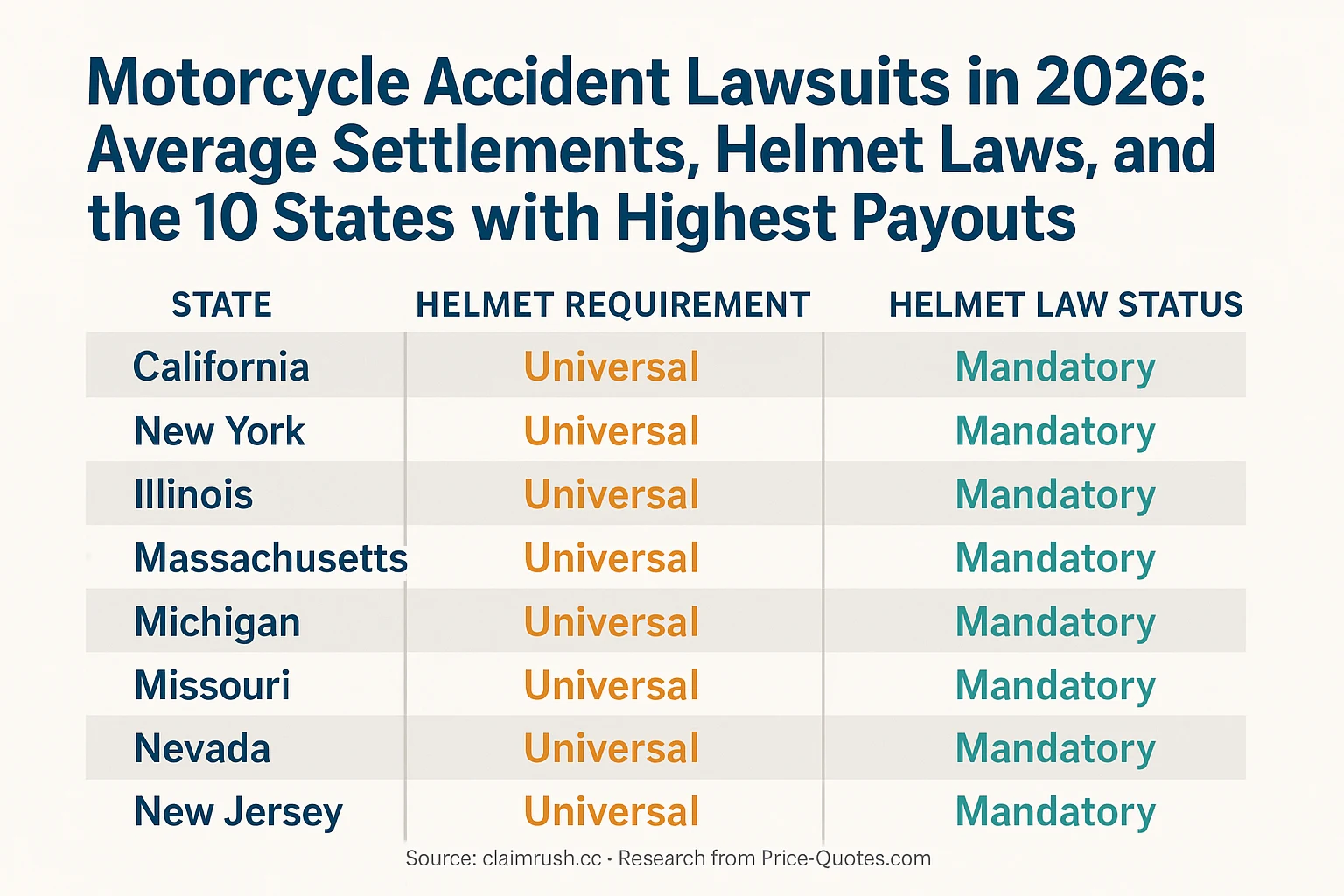
States with Partial Helmet Laws (27 states)
These states require helmets only for riders under a certain age or with less experience:| Age Requirement | States |
|---|---|
| Under 18 | Alabama, Arizona, Colorado, Connecticut, Indiana, Iowa, Kansas, Kentucky, Louisiana, Maine, Maryland, Minnesota, Montana, New Mexico, North Dakota, Ohio, Oklahoma, Pennsylvania, Rhode Island, South Carolina, South Dakota, Tennessee, Texas, Utah, Vermont, West Virginia, Wyoming |
States with No Helmet Laws (3 states)
Illinois, New Hampshire, and Florida do not require motorcycle helmets for adult riders. In these states, helmet non-compliance cannot be used against you in a lawsuit, and there is no statutory presumption of negligence. However, Florida's unique insurance landscape, including its no-fault insurance requirements, creates other complications for accident victims.The Helmet Defense: How Insurance Companies Use It
Even in states where helmets are required, insurance defense attorneys deploy a specific playbook:- They argue that your helmet was not DOT-compliant, even if it carried a DOT sticker
- They claim you improperly fastened the helmet, allowing it to come off during impact
- They retain biomechanical experts who testify that a helmet would have reduced your injuries by a specific percentage
- They argue that your decision not to wear a helmet contributed to "avoidable damages"
The 10 States with Highest Motorcycle Accident Payouts in 2026
Based on analysis of settlement data, jury verdict databases, and insurance carrier reported payouts, these ten states delivered the highest average motorcycle accident settlements in 2026:10. Arizona
Average settlement: $185,000 Median settlement: $95,000 Key factor: Arizona's comparative fault system allows injured riders to recover compensation even when partially at fault, up to 49% fault. Phoenix and Tucson juries have shown consistent plaintiff sympathy in motorcycle cases.9. Washington
Average settlement: $198,000 Median settlement: $112,000 Key factor: Seattle's high verdicts in personal injury cases extend to motorcycle accidents. The state's mandatory helmet law doesn't significantly reduce payouts because most riders comply.8. Massachusetts
Average settlement: $215,000 Median settlement: $128,000 Key factor: Boston juries consistently award substantial pain and suffering damages. The state's no-fault threshold creates incentives for serious injury claims.7. Colorado
Average settlement: $232,000 Median settlement: $145,000 Key factor: Denver's growing motorcycle population has led to more cases and larger verdicts. The state's partial helmet law (under 18) means most adult riders have no helmet defense raised against them.6. Nevada
Average settlement: $258,000 Median settlement: $162,000 Key factor: Las Vegas juries are known for generous awards, and Nevada's tourism-based economy means many accidents involve visitors with good insurance coverage. The mandatory helmet law doesn't deter high payouts.5. New York
Average settlement: $285,000 Median settlement: $178,000 Key factor: New York City alone sees over 3,000 motorcycle accident injuries annually. The state's mandatory helmet law and strong plaintiff verdicts create predictable high-value cases for serious injuries.4. California
Average settlement: $312,000 Median settlement: $195,000 Key factor: California's massive motorcycle population (over 800,000 registered bikes) combined with favorable plaintiff laws and high cost of living means medical damages and lost wages are calculated at higher rates. Los Angeles and San Francisco juries regularly award seven-figure verdicts.3. Florida
Average settlement: $345,000 Median settlement: $215,000 Key factor: Florida's warm weather year-round riding, high tourist traffic, and large senior population (who often cause accidents) create ideal conditions for high-value claims. The lack of a mandatory helmet law means fewer defensive arguments for insurers.2. Texas
Average settlement: $385,000 Median settlement: $245,000 Key factor: Texas's large population, extensive highway system, and plaintiff-friendly courts in major metropolitan areas combine for consistent high payouts. Houston, Dallas, and Austin juries have delivered some of the largest motorcycle verdicts in the country.1. New Jersey
Average settlement: $425,000 Median settlement: $278,000 Key factor: New Jersey consistently ranks first for personal injury payouts across vehicle types. The state's mandatory helmet law, high population density, and courts that routinely award pain and suffering damages well above medical expenses make it the top state for motorcycle accident settlements.What to Do Immediately After a Motorcycle Accident
The hours after a motorcycle accident are critical for preserving your legal rights. Follow this specific checklist:At the Scene
- Call 911 immediately, even if injuries seem minor. Police reports are essential evidence
- Request emergency medical evaluation even if you feel fine. Traumatic brain injury symptoms can appear hours later
- Take photographs of all vehicles involved, your motorcycle from multiple angles, the road surface, traffic signs, and your injuries before treatment begins
- Collect driver information: name, insurance company, policy number, license plate, driver's license
- Get contact information from any witnesses who saw the accident occur
- Note the exact location, time, weather conditions, and lighting
Within 72 Hours
- Obtain your police report from the investigating agency
- Preserve your motorcycle as evidence—do not allow insurance companies to inspect it without your attorney present
- Begin or continue medical treatment and keep detailed records of all appointments
- Do not give recorded statements to any insurance company without legal counsel present
- Document your lost wages with employer letters and pay stubs
Within 2 Weeks
- Consult with a motorcycle accident attorney who has specific experience with these cases
- Request all medical records and bills in writing from every provider
- Begin tracking daily pain levels, mobility limitations, and emotional impact in a journal
- Do not post about your accident on social media—insurance companies monitor these platforms
Why You Need a Motorcycle-Specific Attorney
General personal injury attorneys often lack the specialized knowledge required to maximize motorcycle accident claims. Key differences include: Understanding motorcycle dynamics: A skilled motorcycle attorney understands countersteering, lean angles, and crash physics. This knowledge allows them to effectively counter defense arguments that riders were "driving recklessly" when they were operating their bikes correctly. Expert network: Motorcycle accident cases require different experts than car accidents: motorcycle safety engineers, DOT helmet certification experts, motorcycle accident reconstructionists who specialize in two-wheeled vehicles, and medical specialists who understand crash-related trauma patterns. Insurance company history: Major insurance carriers have specific internal training materials on how to devalue motorcycle claims. Attorneys who know these strategies can counter them effectively. Jury perception management: Many jurors hold unconscious biases against motorcyclists as "reckless" or "risk-takers." Experienced attorneys know how to frame cases to overcome these biases and present riders as responsible enthusiasts who were victimized by negligent drivers.Understanding Your Insurance Options
Motorcycle insurance differs significantly from auto insurance, and understanding your coverage options before an accident is essential:| Coverage Type | What It Covers | Why It Matters for Motorcyclists |
|---|---|---|
| Liability | Injuries you cause to others | Minimum coverage often inadequate; consider 100/300/100 minimum |
| Uninsured/Underinsured Motorist | Other driver has insufficient insurance | Critical protection since many drivers carry minimum coverage only |
| Medical Payments | Your medical bills regardless of fault | Often more important than for car drivers since no PIP coverage exists |
| Collision | Damage to your motorcycle | Required if you have a loan; consider actual cash value vs. replacement cost |
| Comprehensive | Theft, weather damage, etc. | Important for bikes that are seasonal or stored seasonally |
| Gear/Accessories | Helmet, riding gear, custom parts | Standard policies often cap at $1,000; increase this limit |
What to Do Next: Your Action Plan
If you've been injured in a motorcycle accident, the path forward is clear:- Get medical treatment immediately. Your health is the priority, and documentation of your injuries directly impacts your settlement value.
- Consult with a motorcycle accident attorney within 2 weeks. Most offer free consultations and work on contingency fees, meaning you pay nothing upfront.
- Request your police report and preserve all evidence. Do not repair or sell your motorcycle until your attorney reviews the case.
- Review your insurance coverage. Ensure you have adequate uninsured/underinsured motorist coverage for future protection.
- Track every expense. Keep receipts for medical co-pays, transportation to appointments, home modifications, and lost wages.
Frequently Asked Questions
How long do I have to file a motorcycle accident lawsuit? The statute of limitations for motorcycle accident claims varies by state, ranging from 1 year to 6 years from the date of the accident. However, you should not wait until near the deadline to contact an attorney—evidence degrades, witnesses become harder to locate, and medical records become less detailed over time. Most attorneys recommend consulting within 2 weeks of the accident. Will my motorcycle accident settlement be taxed? Generally, motorcycle accident settlements are not taxable income. The IRS considers compensation for physical injuries to be tax-free, including awards for pain and suffering, emotional distress, and loss of enjoyment of life. However, settlements for punitive damages or amounts designated for lost wages may be partially taxable. Your attorney can structure the settlement to maximize your after-tax recovery. Can I still recover damages if I wasn't wearing a helmet? Yes, in most cases. The ability to recover damages depends on your state's helmet laws, whether the helmet would have prevented your specific injuries, and the degree of fault attributed to you. In states without mandatory helmet laws (Illinois, New Hampshire, Florida), helmet non-compliance typically cannot be used against you at all. In other states, the defense must prove that wearing a helmet would have specifically prevented or reduced your injuries. What if the other driver doesn't have insurance? If the at-fault driver has no insurance, your options include filing a claim under your own uninsured motorist coverage, pursuing the driver's personal assets directly, or in some cases, identifying other potentially liable parties (such as the driver's employer if they were working). Uninsured motorist coverage is essential protection that many motorcyclists neglect to purchase. How much is my motorcycle accident case worth? Without reviewing the specific facts of your case, no attorney can give you an accurate value. However, based on 2026 settlement data, minor injury cases typically settle between $15,000 and $35,000, moderate injury cases between $75,000 and $150,000, serious injury cases between $250,000 and $750,000, and catastrophic injury cases can exceed $3 million. The specific factors that determine your case value include the severity and permanence of your injuries, your medical expenses, lost wages, liability evidence, and the jurisdiction where your case is filed.The Bottom Line
Motorcycle accidents are disproportionately costly—in both human and financial terms. The average motorcycle accident settlement in 2026 exceeded $180,000 nationally, with cases involving serious injuries routinely exceeding $500,000. The state where you crash matters significantly, with New Jersey, Texas, and Florida delivering the highest average payouts. Helmet laws create legal complexities but rarely eliminate your ability to recover fair compensation. The most important steps you can take are obtaining immediate medical care, documenting everything, and consulting with an attorney who specializes in motorcycle accidents before accepting any settlement offer from an insurance company. Your motorcycle represents freedom, but when that freedom is interrupted by someone else's negligence, you deserve full compensation for your injuries, your losses, and your pain. The data and strategies in this article are your starting point for understanding what that compensation might look like in 2026.Key Questions
How long do I have to file a motorcycle accident lawsuit?
The statute of limitations for motorcycle accident claims varies by state, ranging from 1 year to 6 years from the date of the accident. However, you should not wait until near the deadline to contact an attorney—evidence degrades, witnesses become harder to locate, and medical records become less detailed over time. Most attorneys recommend consulting within 2 weeks of the accident.
Will my motorcycle accident settlement be taxed?
Generally, motorcycle accident settlements are not taxable income. The IRS considers compensation for physical injuries to be tax-free, including awards for pain and suffering, emotional distress, and loss of enjoyment of life. However, settlements for punitive damages or amounts designated for lost wages may be partially taxable. Your attorney can structure the settlement to maximize your after-tax recovery.
Can I still recover damages if I wasn't wearing a helmet?
Yes, in most cases. The ability to recover damages depends on your state's helmet laws, whether the helmet would have prevented your specific injuries, and the degree of fault attributed to you. In states without mandatory helmet laws (Illinois, New Hampshire, Florida), helmet non-compliance typically cannot be used against you at all. In other states, the defense must prove that wearing a helmet would have specifically prevented or reduced your injuries.
What if the other driver doesn't have insurance?
If the at-fault driver has no insurance, your options include filing a claim under your own uninsured motorist coverage, pursuing the driver's personal assets directly, or in some cases, identifying other potentially liable parties (such as the driver's employer if they were working). Uninsured motorist coverage is essential protection that many motorcyclists neglect to purchase.
How much is my motorcycle accident case worth?
Without reviewing the specific facts of your case, no attorney can give you an accurate value. However, based on 2026 settlement data, minor injury cases typically settle between $15,000 and $35,000, moderate injury cases between $75,000 and $150,000, serious injury cases between $250,000 and $750,000, and catastrophic injury cases can exceed $3 million. The specific factors that determine your case value include the severity and permanence of your injuries, your medical expenses, lost wages, liability evidence, and the jurisdiction where your case is filed.